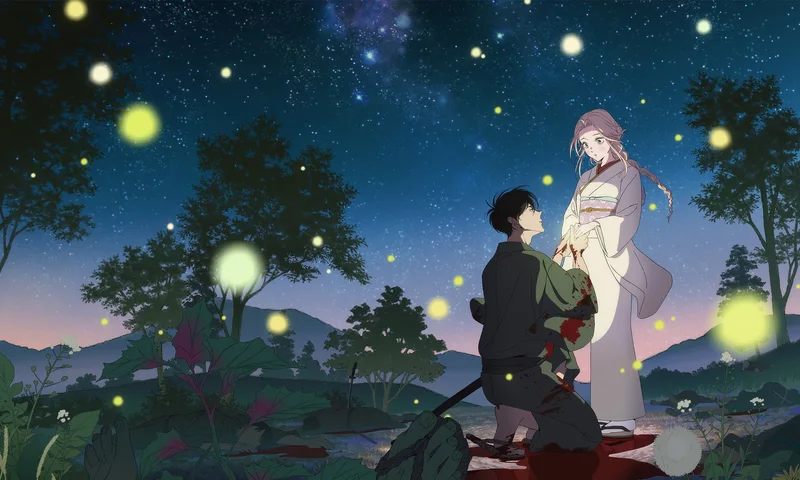
Does Satoko survive?
The final chapter gives an account of Satoko surviving and shows a reunion with Shinpei. Its closing images leave room for interpretation.
Manga fact In Chapter 79, her letter describes recovering her health and working. In the reunion dialogue, she says a foreign doctor summoned by Mitsuharu treated her after Shinpei left. These are statements inside the manga, rather than an explanation supplied by a reader.
Our reading A reunion after survival is the strongest reading of the information the finale supplies. The return to their younger appearances can express how they see one another and recover their shared past.
Left open The transition from an elderly Shinpei falling down to the couple appearing young is unexplained. The chapter does not explicitly call the scene a dream or an afterlife, and it does not show literal physical rejuvenation.
Read alongside Chapters 78–79. Stopping at Chapter 78 produces a different, incomplete account.
What happens in the final chapters?
Manga facts Keep the sequence in view. The crisis, Shinpei’s understanding of it, and the finale’s later explanation are separate pieces of information.
- Chapter 73
A home on the island
Satoko and Shinpei return to the island and try to live together. She explicitly says her ceremony with Mitsuharu was never completed. Her health continues to deteriorate.
- Chapter 76
Their own wedding
They share river water from Shinpei’s hands and declare themselves husband and wife. He gives her a flower hairpin; she gives him a rice bowl, asking him to eat breakfast and care for himself. This is their chosen ceremony; the chapter does not document a civil marriage registration.
- Chapter 77
A choice to hold back
Shinpei encounters men who want revenge over a former employer he killed. He feels the urge to kill them but restrains himself. Later, he carries Satoko to the lookout, where they see fireflies and she tells him she loves him.
- Chapter 78
The apparent loss
Satoko will not wake. Shinpei carries her to the Okumura household; Mitsuharu later emerges in tears and shakes his head. Shinpei leaves believing he has lost her. The treatment inside the room is not shown in full.
- Chapter 78
A reason to keep living
Back in their empty home, Shinpei considers suicide. He finds Satoko’s written hopes for tomorrow and the days beyond it, then lowers the knife. Her plans concern ordinary life together: laundry, greetings, affection and continuing to live.
- Chapter 79 · first part
Years on the road
Shinpei travels, helps villagers and discourages a child from pursuing revenge. He continues to age and retains the cord ring associated with Satoko. Hearing that the island may be demolished brings him back.
- Chapter 79 · second part
The letters and the return home
An elderly Kotaro gives him Satoko’s letters. One describes her recovery and employment. Shinpei then approaches their old home, and the reunion is drawn with their younger appearances. Satoko explains the foreign doctor’s successful treatment; they affirm that their feelings have remained with each other.
Why Chapter 78 is not the final verdict
Our reading Chapter 78 makes Shinpei’s devastation understandable. It lets us experience what he thinks has happened, without displaying every medical event. Chapter 79 supplies information he did not have. The text does not require a claim that she died permanently and was later resurrected.
Who reads the letter at the beginning?
Manga fact · Chapters 1 & 79 The elderly reader is Shinpei. The words about freely choosing love are Satoko’s, contained in her letter. Chapter 79 returns to the opening composition and identifies her handwriting.
The distinction matters: the first-person voice belongs to the writer. It does not make the elderly person holding the letter an older Satoko.
What do the later letters establish?
Manga fact · Chapter 79 Satoko writes about finding work, becoming healthy and waiting for him to come home. Kotaro identifies a letter sent when she received her first salary and says there are many others he could not give Shinpei.
Left open That gives us evidence of life after the crisis. It does not explain the entire communication failure. The chapter does not trace every delivery attempt, show how each person searched, or establish that Kotaro deliberately concealed her survival.
Is the reunion real, a dream, or an afterlife?
Each reading has to account for both the letters and the change in how the couple are drawn. They carry different amounts of support.
Survival, with a symbolic return to youth
Our primary reading The recovery letter and Satoko’s explanation work as revelations of what happened after Shinpei left. Their younger faces can restore the emotional world of the island: to one another, they are still the people who made that promise. This accepts the story’s supplied explanation while reading the visual transition symbolically.
Limit: the manga does not explain the youthful appearances or stage a separate, unambiguous reunion between both elderly bodies.
A dream or vision
Possible reading Shinpei’s fall and the shift into youth can suggest a subjective experience. This may explain the change in the images, but the chapter provides no explicit waking scene or caption identifying a dream. It also requires a further explanation of how the recovery letter relates to that vision.
A meeting beyond death
Possible reading A reunion outside ordinary time can make emotional sense after decades of separation. But the checked chapter does not declare Shinpei dead after his fall or Satoko dead at this reunion. Calling an afterlife the confirmed ending adds information the main text has not supplied.
We therefore read the ending as a hopeful reunion with a symbolic visual transition, while keeping its literal staging open. The other readings are interpretations, not additional manga facts.
What changes between the first promise and the last?
Manga facts · Chapters 1, 70, 76 & 79 Satoko’s opening marriage proposal is made under a threat to her life. At their river wedding, both want an ordinary future together. Shinpei acknowledges in Chapter 70 that he has killed innocent people; his later restraint and assistance to others show a change in his conduct.
Our reading The wedding shifts the promise toward freely chosen companionship. The rice bowl makes that future tangible: eat, come home, take care of yourself, and do it again tomorrow. Its presence at the end of Chapter 78 ties grief to the mundane life they wanted.
Shinpei’s change also asks more of him than loving Satoko intensely. He has to recognise that other people have loved ones and futures, too. The child seeking revenge in Chapter 79 places him in front of a pain he once caused. His refusal to encourage another killing gives that change a concrete test.
Left open Living differently is not evidence that all victims’ families have forgiven him or that his legal responsibility has disappeared. His own Chapter 79 narration rejects the idea that travelling can simply repay his past.
Why the ending can feel happy and painful
Our reading The final embrace gives the romance a hopeful destination. The decades apart still matter. A reunion cannot restore all the shared breakfasts and evenings they missed, and the chapter does not show a long everyday life after it. “Bittersweet and hopeful” fits our reading better than a promise that every loss has been repaired.
The fireflies around the lookout and the final home can be read as a brief light held against that loss. This is a thematic connection drawn from the images, rather than a stated rule about death or the supernatural.
What does the manga leave unexplained?
Left open in the checked main story A gap can be a fair reason to find the ending unsatisfying. It does not, on its own, prove a particular hidden plot.
- The length of the separation. The finale shows ageing over years and refers to decades. We did not find an exact “50 years” interval in the checked text; exact ages should not be calculated from their faces.
- The failure to reconnect. Why did the letters and searches fail for so long? Kotaro’s dialogue leaves the delivery process incomplete.
- The medical sequence. Satoko says the foreign doctor treated her successfully after Shinpei left. The chapter does not give a precise diagnosis, procedure or full account of the earlier failed treatment.
- The visual transition. How should the fall, young appearances and final embrace be understood literally? The closing scene supplies no explicit explanation.
- Life after the reunion. The embrace closes the main story. It does not provide a detailed later household history or settle every consequence of Shinpei’s crimes.
A few common questions
Did Satoko marry Mitsuharu?
Manga fact · Chapter 73 Satoko says their ceremony was never completed. Chapter 76 instead shows her own wedding with Shinpei. The finale’s account of Mitsuharu arranging a doctor does not establish a later marriage to him.
Did Shinpei kill himself?
Manga fact · Chapters 78–79 He lowers the knife in Chapter 78 and is shown living and travelling for years in Chapter 79. His later fall is not explicitly identified as his death.
Did Kotaro deliberately hide the letters?
Left open · Chapter 79 He says there are letters he could not deliver. That is insufficient to establish deliberate concealment, jealousy or a scheme involving Mitsuharu.
Is it a happy ending or a bad ending?
Our reading We read it as a bittersweet, hopeful reunion. That is an assessment of the closing scenes, not a category announced by the manga. Readers can reasonably find the unexplained separation painful or unconvincing.
For the people and relationships behind these scenes, visit the manga reader’s companion. For a new series, try our next-read guide.